
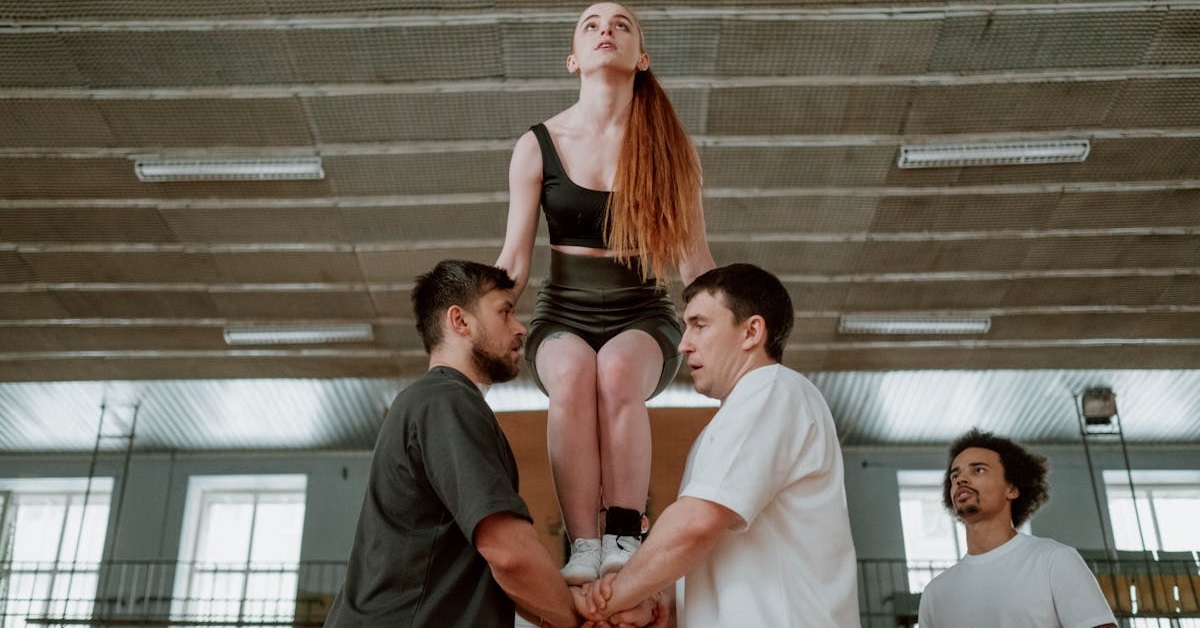
Cheerleading is not just dancing with pom-poms. The real difficulty comes from stunts. These moves demand strength, balance, timing, and full trust between teammates. One mistake can lead to serious injury, which is why only trained cheerleaders perform advanced stunts. Some stunts are so hard that only elite teams even attempt them after years of practice.
Jump to
Below are the hardest cheerleading stunts and what makes each one difficult.
Basket toss full twists
In a basket toss, two or more bases lock their arms together to create a “basket.” The flyer stands in it and is thrown straight up into the air. In a full-twist basket toss, the flyer spins completely before being caught.
This stunt is difficult because of height, speed, and control. The flyer goes very high and must spin fast while staying tight in the air. Losing body control can throw off the rotation. At the same time, the bases must track the flyer’s movement with their eyes and arms. The catch has to be soft but secure.
Two full twists make this stunt even more dangerous. The flyer spins twice before landing, leaving very little time to prepare for the catch. Only elite teams perform this skill safely.
One-arm extensions
One-arm extensions are among the most difficult partner stunts in cheerleading. In this stunt, the flyer stands on a single hand of the base while being held fully overhead.
The main challenge is strength and balance. The base is holding an entire human body with one arm, often while standing still. The flyer must squeeze their core and legs tightly to avoid wobbling. Even small movements can cause shaking, which puts everyone at risk.
This stunt has almost no room for error. There is no second hand for backup support. Both the flyer and base must be completely locked in and confident.
Tick-tock stunts
A tick-tock stunt involves switching feet while staying in the air. The flyer begins standing on one foot, pops up, switches feet mid-air, and lands back into another single-leg stunt.
Timing is the biggest challenge here. All bases and the flyer must move together at the exact same moment. If the flyer switches feet too early or too late, the stunt will fail. The bases must dip and pop with equal force to keep the flyer balanced.
Tick-tocks also demand full body control from the flyer. Any looseness during the switch can cause the stunt to fall apart.
Suspended splits
In suspended splits, the flyer is held in a full split position while lifted in the air by bases holding each leg.
This stunt is painful as well as difficult. Flexibility alone is not enough. The flyer must keep their upper body tight and centered while the legs are being pulled apart. Bases must control the flyer evenly. If one side is stronger, the flyer twists and loses balance.
Suspended splits also demand strong grip strength and steady arms from the bases. This stunt tests endurance more than speed.
Rewind to extensions
A rewind begins when the flyer flips backward into the arms of the bases. Without stopping, the bases lift the flyer up into a full extension.
This stunt is scary because the flyer cannot see the catch. The flyer jumps backward on pure trust. The bases must catch cleanly and absorb the force of the flip before immediately pressing the flyer overhead.
One bad catch or slow lift makes this stunt unsafe. It requires confidence, strength, and perfect coordination.
Switch up stunts
In a switch up, the flyer does not step into the stunt normally. Instead, they jump, switch feet or body position in the air, and land directly into the stunt.
This stunt adds extra movement to an already difficult lift. The bases must be strong and fast. The flyer must finish the switch exactly on time so the bases can catch correctly.
Even experienced teams struggle with switch ups because timing matters more than raw power. One small delay can cause a fall.
Scorpion extensions
Scorpion extensions combine flexibility with balance. The flyer stands in a full extension and pulls one foot behind their head.
This stunt is hard because the flyer is balancing on one foot while bending their spine backward. This shifts the body’s center of balance, making it harder for the base to control.
The base must keep their arm steady with no shaking. Any movement is amplified at full height. The flyer also needs strong shoulders and core muscles to maintain the position.
Arabesque pyramids
In arabesque pyramids, multiple stunt groups connect together while flyers hold arabesque positions. Each flyer stands on one leg with the other leg extended behind them.
The difficulty comes from connection and control. Every flyer must hold their position perfectly at the same time. If one flyer wobbles, it affects the entire pyramid.
This stunt requires total awareness. Flyers must stay focused on balance while also being connected to others. Bases must stay solid and alert the whole time.
Double-down dismounts
A double-down is a backward flipping dismount from an extension into a cradle. The flyer flips twice before landing in the bases’ arms.
This is one of the hardest and most dangerous dismounts in cheerleading. The flyer cannot see the bases during the flip. Rotation speed must be exact. Too fast or too slow makes the landing unstable.
Many cheerleading injuries happen during dismounts because fatigue sets in after holding the stunt. That makes double-downs especially risky.
Cheerleading stunts demand extreme control, strength, and trust. These hardest stunts show the physical and mental intensity of the sport. Behind the smiles and sharp moves are skills that take years to master and leave no room for mistakes.